

The increasing demand for sustainable energy has highlighted the need for alternative biofuel sources with minimal environmental impact. Algae are a promising candidate due to their rapid growth and high lipid content, which serves as the raw material for biodiesel production. However, conventional lipid extraction methods are inefficient and energy-intensive. This project aims to improve the process by genetically engineering Nannochloropsis algae to continuously secrete lipids without harming cell viability. By enhancing lipid transport mechanisms, we facilitate the movement of lipids into engineered vesicles, which are optimized for secretion. These modifications work together to enable efficient, continuous lipid release into the surrounding medium. The secreted lipid-filled vesicles can then be collected through simple filtration, eliminating the need for costly and destructive extraction processes. Once extracted, the lipids can be converted into biodiesel through transesterification, while the remaining biomass is recycled. By integrating genetic modifications that enhance vesicle-based secretion, this approach improves lipid extraction efficiency, making algae-based biofuels more scalable, cost-effective, and environmentally sustainable.
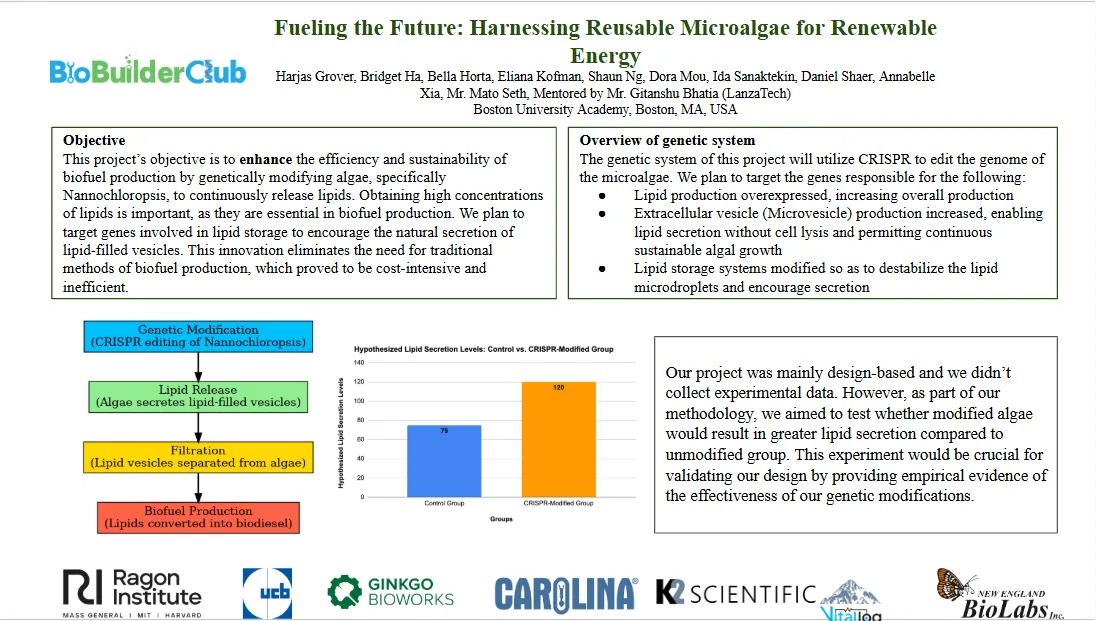
Fueling the Future: Harnessing Reusable Microalgae for Renewable Energy
School
Boston University Academy
Boston, MA
BioBuilderClub Season
2024-2025 Season
Category
Resources
EDITED BBC Poster_Boston University Academy_2025
Biobuilders_BUA_ Lightning Talk Slide (1)
Boston University Academy Abstract-3-2-25 (1)