

Propionibacterium acnes (P. acnes) naturally lives on human skin but can lead to the formation of acne. It releases lipase GehA, which hydrolyzes triglycerides in sebum into free fatty acids that contribute to inflammation. This project aims to develop a synthetic biology-based approach to inhibit GehA activity, by engineering a skin-compatible bacteria like Staphylococcus epidermidis to secrete a short peptide lipase inhibitor. As proof of concept, we would first transform an Escherichia coli (E. coli) bacteria for competitive inhibitor production and secretion. Our genetic circuit would include a plasmid with a strong promoter (pTet), a secretion signal (PelB signal peptide), lipase inhibitor gene (design our own), and a transcription terminator. The plasmid will be introduced to the E.coli for initial testing. A p-nitrophenyl palmitate (pNPP) assay will be conducted to test its ability to reduce lipase activity. If successful, the system will then be tested in skin-like conditions and implemented in Staphylococcus epidermidis to enable in situ inhibition of P. acnes lipase activity. This approach presents a novel microbiome-engineering strategy for acne treatment, leveraging synthetic biology to regulate skin microbial interactions. It addresses the root cause of acne with hopefully less side effects than more aggressive therapies. Future work will focus on optimizing secretion, confirming activity in a skin-like environment, and assessing feasibility for therapeutic application.
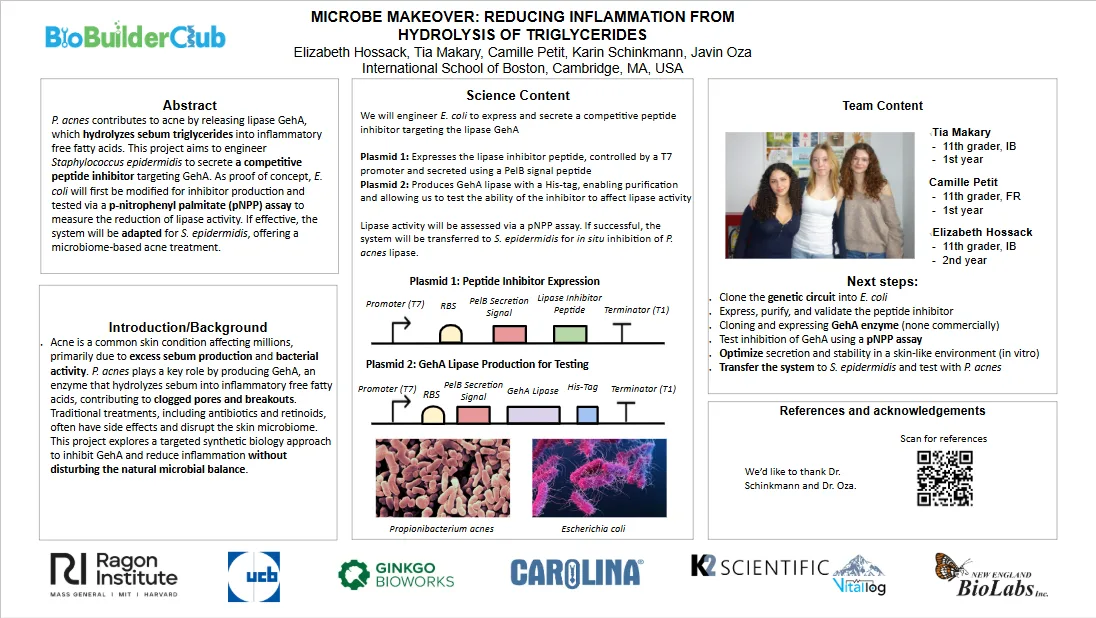
Microbe Makeover: Reducing Inflammation From Hydrolysis of Triglycerides
School
International School of Boston
Cambridge, MA
BioBuilderClub Season
2024-2025 Season
Category
Resources
Abstract_Team 2_International School of Boston_2025