

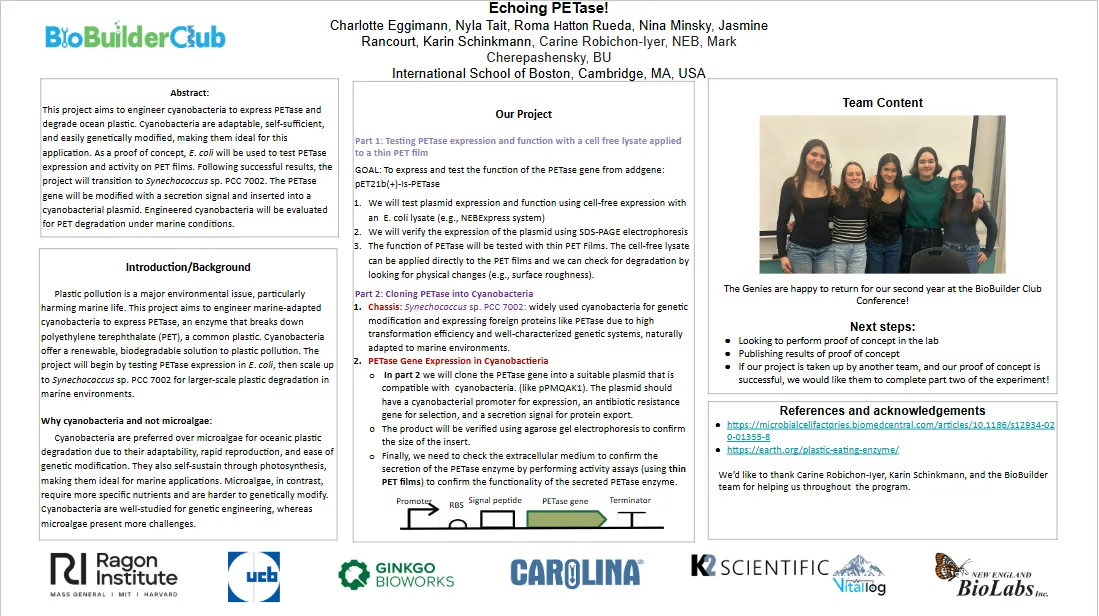
Innovative biodegradation strategies are necessary because plastic pollution is greatly damaging the marine ecosystem. The purpose of this project is to engineer cyanobacteria to express PETase in order to degrade ocean plastic. Cyanobacteria are photosynthetically self-sufficient and can rapidly adapt, meaning they can be genetically modified with ease, so they are more beneficial.
As a proof of concept, the project begins with E. coli to assess PETase expression and activity. The PETase gene will be cloned into E. coli, expressed in a cell-free lysate, and applied to thin PET films to evaluate degradation efficacy. Successful expression and activity will then guide the transition to Synechococcus sp. PCC 7002, a marine-adapted cyanobacterium with high transformation efficiency. The PETase gene will be modified with a secretion signal and inserted into a cyanobacterial expression plasmid (pPMQAK1). Following transformation, engineered cyanobacteria will be assessed for enzyme secretion and PET degradation activity under marine-like conditions.
This study aims to establish a sustainable, biologically driven method for mitigating oceanic plastic waste, providing an approach that can be applied on a large scale in the future.