

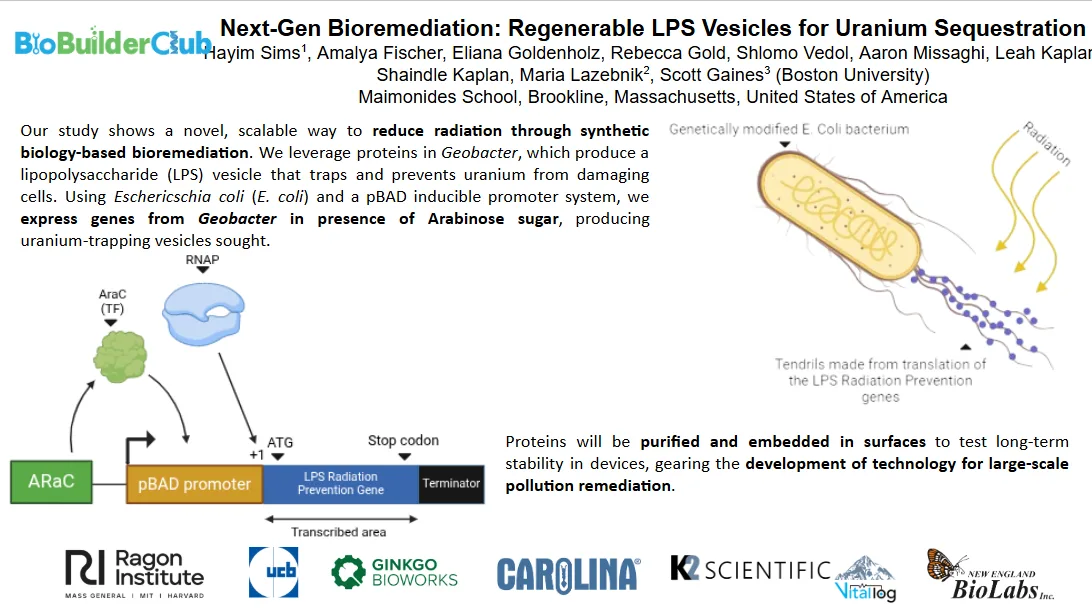
Nuclear power plants serve as potent sources of alternative energy. However, atomic energy generates harmful byproducts through the release of irradiated substances, such as uranium. Exposure to heightened levels of ionizing radiation from uranium can damage cells, impair organ functionality, and, in sufficient quantities, act as a carcinogen. Lead-lined storage containers can store uranium until radioactive decay functions; nevertheless, lead in itself can cause harmful health and neurodegenerative effects, and the substance itself remains a potential danger when stored in mass quantities.
Our study showcases a novel, highly scalable way to reduce radiation pollution by means of synthetic biology-based bioremediation. We leverage proteins characterized in the bacterial strain Geobacter sulfurreducens (Geobacter), which produce a lipopolysaccharide (LPS) vesicle that traps uranium and prevents it from entering and damaging a cell’s contents. On this basis, our system uses Escherichia coli (E. coli) and a pBAD inducible promoter system to express genes transformed from Geobacter to efficiently provide the bioremediation effects sought. The sequences are further modified with Nickel-NTA (Ni-NTA) tags to allow for purification of the product, and a Sterile Alpha Motif (SAM) for embedding within materials to construct vesicles necessary for capturing uranium deposits. Ease of production through the E. coli-based system ensures capabilities for mass production, and the embedding structure enables the LPS vesicle structure to be regenerated after usage for continuous utilization of the product in safely dispersing and remediating uranium waste.
Our approach will aid in nuclear facilities and the creation of devices geared towards radiation protection. Moreover, this study elaborates upon a simple yet effective methodology for designing and applying protein systems through techniques in synthetic biology for potent, wide-scale waste remediation.