

Each year, approximately 400 million metric tons of plastic are produced globally, with polyethylene terephthalate (PET) contributing 14% to that amount. Only 5% of the PET is recycled, 15% is incinerated, and 75% is landfilled. In recent years, enzymes such as PETase, from Ideonella sakaiensis, and leaf compost cutinase (LCC), found in compost piles, have shown potential in addressing this long-standing issue. However, the temperature of piles in recycling facilities is often 55-60°C, so a thermostable enzyme like LCC is needed. Two different forms of LCC were observed, one with the original sequence and another engineered to be more thermostable. The engineered LCC ultimately worked better compared to the original LCC. The efficiency of PETase and LCC against PET film (0.25mm thickness) and PET powder (300 um) was evaluated. Both enzymes were expressed in a cell-free system (BioBits) by adding DNA at 100ng/ul, and using green fluorescence protein (GFP) as a reporter. The level of expression was inferred using ImageJ to quantify fluorescence. The enzymes were then applied to both the PET film and powder and incubated for five days. Imaging with scanning electron microscope (SEM) indicated that PET films with engineered LCC showed decomposition and PET powder particles with engineered LCC had smoother and rounder edges when compared with negative controls.
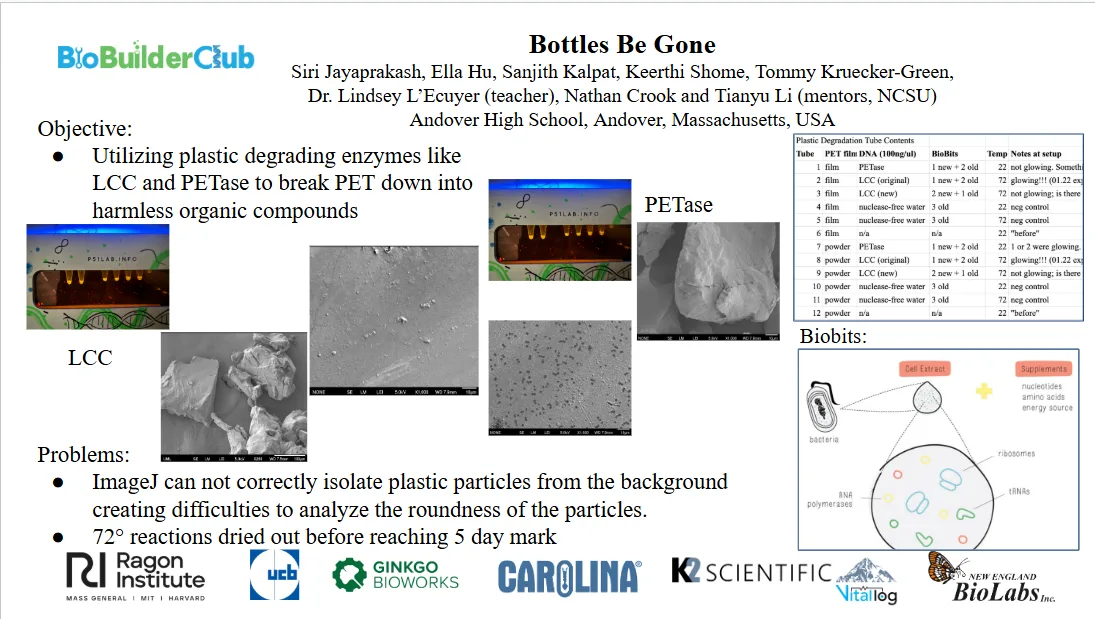
Expression of PETase and LCC Degrade PET Film and Powder
School
Andover High School
Andover, MA
BioBuilderClub Season
2024-2025 Season
Category
Resources
Andover Bottles Be Gone BioTreks Article
BBC LT_BottlesBeGone_Andover High School_2025
EDITED BBC Poster_BottlesBeGone_Andover High School_2025 (1)