

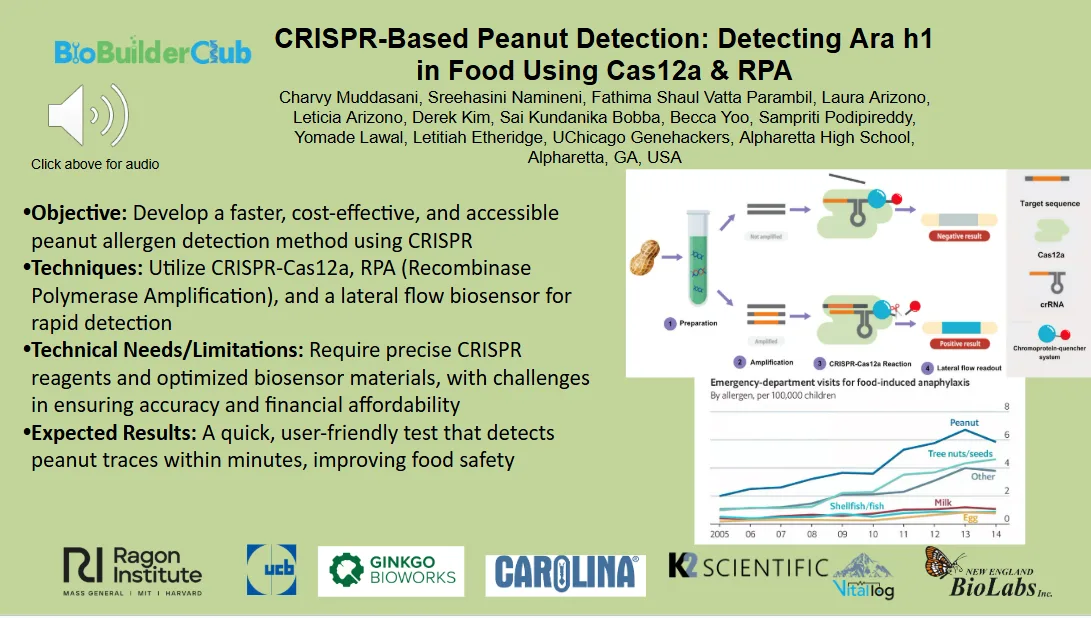
The increasing prevalence of peanut allergies poses a critical public health threat to millions worldwide. One of the biggest challenges in managing peanut allergies is detecting trace amounts of peanuts in food. Many are unaware of the potential peanut ingredients that are found in processed foods. Additionally, cross-contamination is common in restaurants and manufacturing facilities. Currently, detecting peanuts in food typically requires lab-based methods such as ELISA (enzyme-linked immunosorbent assay) or PCR (polymerase chain reaction), which, while highly sensitive, can take hours to complete and require specialized equipment.
We are developing a faster and more accessible detection method using the DETECTR system, which integrates CRISPR-based technology for highly specific DNA recognition. Our approach employs recombinase polymerase amplification (RPA), an isothermal amplification technique, to rapidly increase the DNA concentration of a major peanut allergen, Ara h1, in food samples. The CRISPR-Cas12a enzyme will then identify the target dsDNA sequence. Upon binding, Cas12a activates collateral cleavage of an ssDNA reporter linked to the chromoprotein amilCP, generating a visible color change. This reaction will be incorporated into a lateral flow biosensor to create an easily interpretable test. Our project aims to develop a faster, cost-effective method for detecting peanuts in food to help individuals with peanut allergies make safer choices. By improving detection speed and accuracy, we hope to reduce the risk of accidental exposure and severe allergic reactions.